
Why Boat Seat Seams Are Silently Destroying Your Marine Upholstery (And How to Stop It)

If you've ever looked at your boat seats and noticed cracking vinyl, a musty odor, or cushions that feel soft and spongy in all the wrong ways, the culprit is probably hiding in plain sight.
It's the seams.
When it comes to boat seating, every seam matters. And understanding why could save you hundreds—or even thousands—of dollars in repairs.
What Are Boat Seat Seams and Why Do They Matter?
Boat seat seams are the stitched joints that hold panels of marine vinyl together to form cushions, backrests, and seat bases. Every time an upholsterer cuts a piece of material and sews it to another, that junction becomes a seam.
On land, seams in furniture are a minor concern. On water, they're a structural vulnerability.
Marine environments are uniquely hostile to upholstery. Constant exposure to UV rays, humidity, salt air, wake spray, and rain means that every seam on a boat seat is a potential entry point for water and once water gets in, the damage compounds fast.
How Water Enters Through Boat Seat Seams
Even the most carefully stitched seam isn't truly waterproof. Thread creates tiny channels, and over time:
Repeated flexing from passengers sitting down and standing up opens microscopic gaps in the stitching
UV degradation breaks down thread and vinyl around the seam edge
Temperature cycling causes materials to expand and contract, stressing the seam from the inside
Standing water pools along seams and seeps into the foam core below
Once water infiltrates the foam, the damage accelerates in three key ways:
1. Mildew and Odor Buildup
Boat seat foam is like a sponge. Wet foam becomes a breeding ground for mold and mildew, producing that unmistakable musty smell that's nearly impossible to fully eliminate once established. Mildew doesn't just smell bad, it actively degrades foam and vinyl from within.
2. Foam Breakdown
Marine-grade foam is designed to resist moisture, but it's not immune to prolonged saturation. Waterlogged foam loses its density, its shape, and its structural support. Cushions that once felt firm and supportive become soft, lumpy, and uncomfortable. This is a sign the core is breaking down.
3. Vinyl Weakening from the Inside Out
Most people assume vinyl fails from the outside when they see cracking from sun exposure, and while UV damage is real, boat seat vinyl that is constantly wet underneath delaminates and weakens from the inside out. The backing separates from the face, making the vinyl brittle, prone to tearing, and nearly impossible to repair effectively.
Seams Are the First Place Marine Upholstery Fails
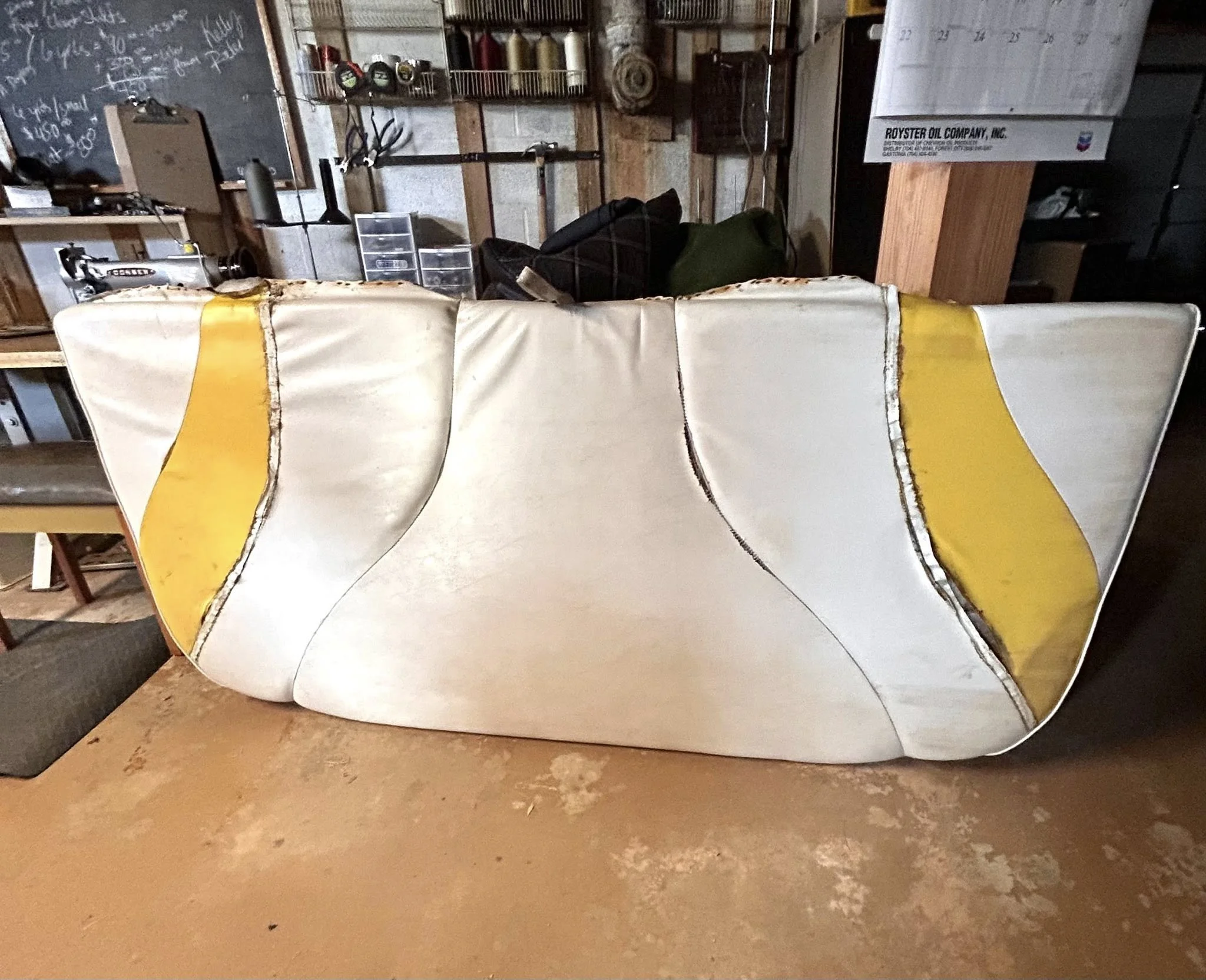
What starts as a small seam tear usually means there’s a bigger issue underneath. Once stitching begins to fail, water can enter the foam, weakening the seat from the inside out. In marine upholstery, seam placement and construction matter just as much as the vinyl itself.
This is one of the most overlooked truths in boat seat maintenance: seams are always the first place upholstery fails.
It's not random. It's physics and chemistry working against you.
Each seam is a stress concentration point. When someone sits down, the vinyl flexes and seams bear the brunt of that stress. The more seams a cushion has, the more stress points there are. The more stress points, the more opportunities for:
Splitting along the seam line
Thread rot leading to unraveling stitches
Vinyl tearing away from the seam edge
Water intrusion at each failure point
Think of it like a chain. The weakest link breaks first and in marine upholstery, seams are always the weakest links.
The Problem with Over-Paneled Boat Seats
Many factory boat seats and lower-quality aftermarket replacements are often constructed with overly complex paneling and unnecessary decorative sections sewn together to achieve a stylized appearance. While this can appear impressive at first glance, it dramatically increases the number of seams and, therefore, the number of potential failure points.
A seat built with five separate panels has roughly twice the linear seam length of one built with three. That means:
Twice the water entry risk
Twice the stress points
More thread to rot and fail
Harder, more expensive repairs down the road
This is why experienced marine upholsterers think carefully about paneling strategy, not just aesthetics.
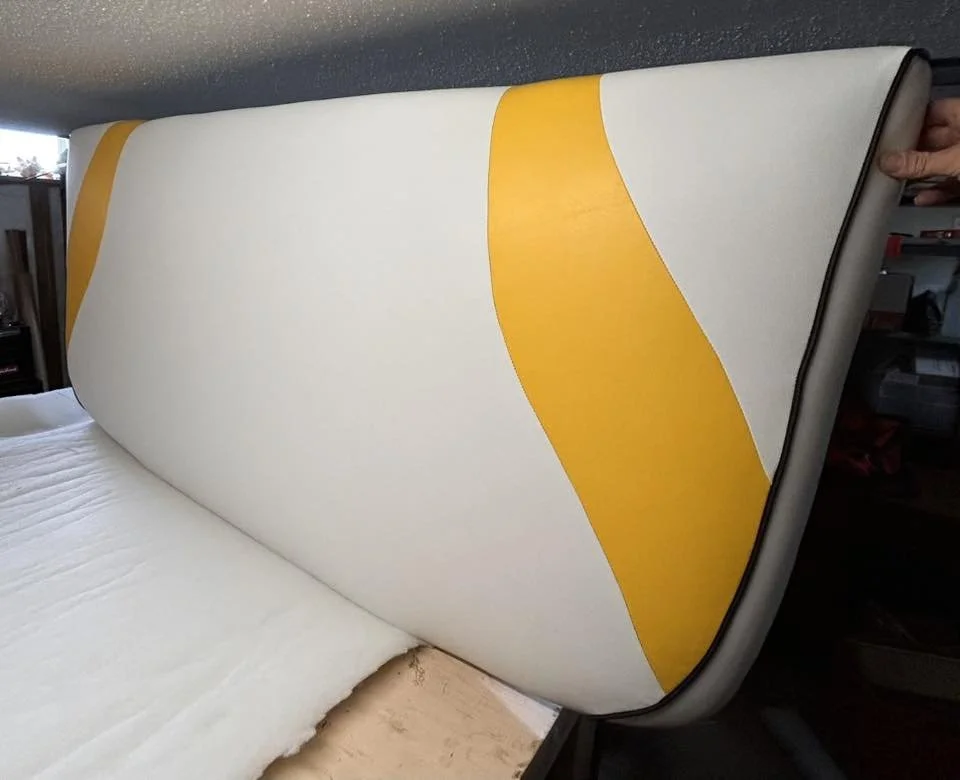
By reducing unnecessary seams and redesigning panel layouts, we can create boat seating with fewer weak points, fewer areas for tears to start, and fewer places for water to enter the foam.
Fewer Seams = Fewer Failure Points = Longer-Lasting Boat Seats
The solution isn't complicated, but it requires skill and intentionality in the design phase.
When possible, simplifying paneling and reducing unnecessary seams produces a dramatically more durable seat. This means:
Using larger single-cut panels instead of piecing together multiple smaller sections
Placing seams strategically away from high-stress flex zones
Eliminating decorative seams that add no structural purpose but multiply failure risk
Using quality marine thread rated for UV and saltwater exposure at every remaining seam
The result is a seat that looks clean, lasts longer, resists water infiltration more effectively, and requires fewer repairs over its lifespan.
This isn't just a theory, it's a design philosophy that makes a measurable difference in the real world.
Signs Your Boat Seat Seams Are Failing
Watch for these warning signs that seam failure has begun or is accelerating:
Visible Damage:
Splitting or cracking along seam lines
Stitching that has pulled through or unraveled
Vinyl that is pulling away at the seam edge
Discoloration or dark staining along seams
Hidden Damage:
Soft or spongy feel when pressing on cushions (wet foam)
Musty or mildew odor that won't go away after cleaning
Cushions that take a long time to dry after rain or spray
Vinyl that feels loose or bubbled beneath the surface
If you're noticing two or more of these signs, it's likely that water has already infiltrated the foam core. Surface-level repairs like patching the vinyl without addressing the foam and the seam design will only delay the inevitable.
Why a Smarter Rebuild Beats a Simple Recover
When most boat owners see failing upholstery, the instinct is to get it "recovered". It's faster and often cheaper upfront.
But here's the problem: if the foam is compromised and the seam layout is the same, the new vinyl will fail for the same reasons as the old vinyl.
A smarter rebuild means:
Replacing waterlogged or degraded foam with fresh marine-grade material
Redesigning the panel layout to minimize seam count and optimize seam placement
Using high-quality marine vinyl rated for UV, salt, and mildew resistance
Applying proper backing and bonding to ensure vinyl adheres fully to foam without gaps
This approach costs more than a simple recover, but it lasts years longer, performs better, and protects your investment in your boat.
Boat Seat Upholstery FAQs
How long should boat seat upholstery last?
Quality marine upholstery, properly built and maintained, should last 8–15 years. Seats that fail within 3–5 years typically have compromised foam, poor-quality vinyl, or a seam design that accelerates water infiltration.
Can I repair a split boat seat seam myself?
Small seam repairs are possible with marine vinyl repair kits, but they are rarely permanent. A repaired seam is structurally weaker than the original and often fails again quickly—especially in high-flex areas. For lasting results, professional restitching or panel replacement is recommended.
What causes boat seat vinyl to crack?
Cracking is caused by a combination of UV exposure, heat cycling, and dryness. Without regular conditioning, marine vinyl loses flexibility and becomes brittle. Cracking often starts at or near seams where stress is concentrated.
How do I prevent mildew in boat seat foam?
The best prevention is minimizing water entry through seams in the first place. Additionally, allow seats to dry fully after use, use marine-grade mildew-resistant foam, and clean vinyl regularly with a UV protectant product.
Is boat seat foam replaceable?
Yes. Marine foam can be cut to match original dimensions and replaced independently of the vinyl in some cases. However, in most professional rebuilds, foam and vinyl are replaced together to ensure proper fit and adhesion.
What's the difference between marine vinyl and regular vinyl?
Marine vinyl is engineered specifically for outdoor, wet environments. It includes UV inhibitors, mildew-resistant backing, and enhanced flexibility to handle temperature extremes. Regular furniture vinyl will degrade rapidly in a marine environment.
Serving Cleveland County and Surrounding Areas
If your boat seats are cracking, splitting, holding moisture, or just looking worn out—don't settle for a band-aid fix that won't last.
We specialize in smart boat seat rebuilds that address the root causes of failure: the foam, the vinyl, and most importantly, the seam strategy. Fewer seams. Better materials. Longer-lasting results.
📩 Send us a photo of your boat seats for a free quote.
We proudly serve boat owners around Lake Hickory, Lake James, Moss Lake and surrounding areas. Whether you've got a fishing boat, pontoon, ski boat, or center console, we'll assess what you've got and give you an honest recommendation—recover, repair, or full rebuild.
Your boat seats work hard. They deserve to be built smarter.